
Where Robotic Mowers Fit in Municipal Grounds
Most municipal acreage is autonomous-cuttable — the broad lawn panels and corridor zones where 24/7 daily-cut frequency produces the largest labor and budget gains. Detail zones around memorials, signage, and irrigation hardware still need operator precision.
The pitch for a commercial robotic fleet on municipal grounds is fundamentally different from the residential "set it and forget it" framing. Cities, counties, and parks departments operate under tight budget cycles, public-works procurement timelines, and visible public-use windows. The question isn't whether a robot can mow well enough — the question is which zones can we hand off to autonomous daily cutting without compromising the daily visual standard, how do we schedule around early-morning public-use windows, and how much of the existing seasonal mowing-crew budget does that free up.
The answer lays out clearly across a typical municipal footprint:
- City parks and neighborhood greenways (~40–60% of municipal mowed acreage). The bulk of the visible public green space — neighborhood parks, recreation fields, and trail-side corridor bands. RTK GPS handles this segment as long as you mount a reference station with clear sky view; the daily-cut pattern keeps high-visibility park frontage (and the council-member photo-op turf) consistent without the patchy look that comes from weekly hand-trimming crews.
- Public cemeteries and memorial-grounds grids (~15–25%). The section-by-section gridded turfed acreage between grave markers. RTK GPS section-grid mapping makes the multi-zone scheduling reliable, while operator precision keeps the headstone-surround detail at walk-cut quality.
- School grounds and corporate-campus public acreage (~15–25%). Daytime-use-constrained acreage where night and early-morning autonomous runs deliver the cut before students or staff arrive — quiet battery-electric operation below the 60 dB noise floor that adjacent residential properties notice from handheld equipment starts.
- Roadside corridors and rights-of-way (~5–10%). The narrow turf strips between sidewalks and streets that have historically been tough to mow safely. Wire-free RTK boundary keeps the mower off the curb, and 4G cellular telemetry means a single operator oversees a multi-corridor deployment.
What commercial autonomous platforms still don't do well today is the operator-required detail tier: cemetery memorial and headstone surrounds (precision walk-cut around individual markers), signage-bordered detail zones (interpretive signs, donor plaques, dedication markers), and irrigation-stand surrounds (sprinkler heads, valve boxes, drainage grates). Those still require operator precision because the cutting height tolerance, the bed-edge trim line, and the pattern of detail work are too tight for current autonomous platforms. In practice, a municipal deployment runs 24/7 on the high-acreage zones while the parks staff shifts focus to the detail tier — and that's where the labor-cost and budget story comes from.
What Municipal Grounds Need From a Commercial Mower
Seven operating dimensions matter for a municipal deployment — coverage, slope, GPS/RTK multi-zone with cemetery section grid, dust/debris durability, early-morning noise, fleet software, and curfew-aware scheduling.
| Dimension | Municipal Requirement | Why It Matters |
|---|---|---|
| Coverage per cycle | 0.5–2 acres per cycle for daily-cut parks | Allows a small fleet to cover neighborhood parks and recreation fields in a single 24-hour cycle with scheduled handoffs between cemetery sections, school grounds, and adjacent park frontage. |
| Slope handling | 35–70% maximum slope | Cemetery embankments, park hillside trails, and stormwater-channel banks are constantly in the workers' comp exposure zone — AWD platforms remove the operator from that risk. |
| GPS/RTK multi-zone | Section-grid cemetery mapping | Cemeteries are inherently multi-zone — per-section RTK boundary maps let a 1–2 unit fleet hand off sections through the night without operator intervention, with theft-aware PIN/GPS-tagged units reported back to the parks dashboard. |
| IP rating | IPX5 sealed chassis | Autumn leaf-fall, post-storm debris exposure, and wet clipping clumps punish unsealed chassis. IPX5 or better is the floor for parks-department duty cycles that run through leaf season without operator hand-cleaning. |
| Noise level | < 60 dB at 10 m | Early-morning autonomous runs typically start before 6am adjacent to residential properties — the unit needs to be quieter than a casual conversation at the property line, well below the noise-floor complaints triggered by gas-powered equipment starts. |
| Fleet management | Cloud dashboard with theft alerts | Parks manager needs battery, blade wear, route status, and GPS-tagged theft alerts across every unit — a single dashboard view across the entire municipal fleet. Anti-theft PIN and GPS-tagging are standard on commercial-grade units in this segment. |
| Scheduled windows | Curfew-aware scheduling | Mowing windows must respect public-use schedules — parks are quiet before 7am, schools open at 8am, cemeteries have visitation patterns. Per-zone curfew scheduling keeps the autonomous run invisible to the public. |
Recommended Mowers for Municipal Grounds
Four platforms cover the bulk of US-available municipal deployments in 2026 — paired by acreage profile, theft/vandalism posture, and cemetery-grid or school-grounds scheduling demands.
The flagship commercial autonomous platform for large-zone municipal mowing. CEORA cuts up to roughly 6 acres per day on a single charge, navigates with EPOS RTK reference-station accuracy, and runs on Husqvarna Fleet Services cloud software — a single dashboard where the parks manager sees every CEORA's battery, blade wear, route, zone handoff, and theft alert. Standard choice for parks departments running 2+ unit fleets across neighborhood parks, recreation fields, and corporate-campus public acreage.
Check CEORA on Amazon → Husqvarna brand hub →Kress's flagship commercial-grade platform handles 2.0+ acres per cycle with a 12-inch cutting deck and the same RTK reference-station model that CEORA uses. Mission Mega is well-suited to mixed municipal deployments that combine cemetery section-grids with neighborhood park acreage; per-section zone maps in the Kress app let a parks-department supervisor dispatch units to different sections of the cemetery overnight without operator intervention. One of the few consumer-accessible commercial-grade wire-free platforms shipping to US customers with full municipal-segment support.
Check Mission Mega on Amazon → Kress brand hub →The slope and theft-aware workhorse. Automower 535 AWD is rated for 70% (~35 degree) slope handling with pivot-style AWD traction, and ships with built-in GPS-tag theft detection plus the PIN-required restart that municipal procurement teams specifically specify for unattended-deployment risk. The right pick for parks departments that want anti-theft protection on unattended public-property units alongside AWD traction on cemetery embankments and stormwater-channel banks where walking-behind-equipment operators historically take injury.
Check 535 AWD on Amazon → Husqvarna brand hub →The wire-free per-zone RTK specialist. Mammotion Luba 2 AWD runs Vision Fusion + RTK without a fixed reference station, so it's a strong fit for municipal fleets that don't want to mount a permanent RTK base on a maintenance building rooftop — it self-calibrates per field or section. Standard anti-theft PIN and GPS-tag on the unit, and 80% slope handling makes it ideal for cemetery embankments. Pairs naturally with a CEORA or Mission Mega fleet on the larger park-frontage zones.
Check Luba 2 AWD on Amazon → Luba 2 AWD review → Mammotion brand hub →On-Grounds Scenes
Three zones that show up on a typical municipal deployment plan — public-park perimeter in autumn leaf-fall, cemetery section-grid RTK zones, and school grounds early-morning autonomous run.
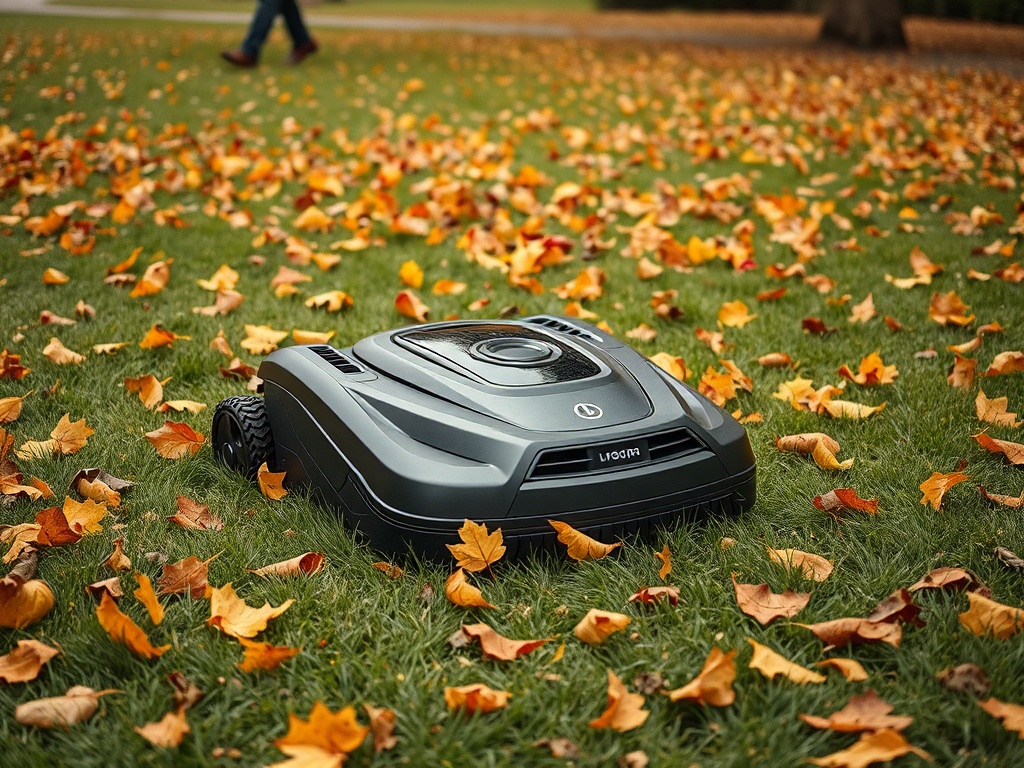
Autumn leaf-fall puts IPX5 sealed chassis at the front of the requirement list. Daily-cut frequency through October and November keeps the leaf mulch layer from smothering the turf, and the wire-free RTK boundary stays reliable through the wet-clipping and debris exposure of leaf season.

Cemetery section-grids map cleanly onto RTK zone boundaries. A 1–2 unit fleet hands off section-by-section overnight, leaving the headstone-surround detail to the precision walk-cut crew. GPS-tag theft alerts keep unattended units accountable on public grounds.

Quiet battery-electric operation below 60 dB makes a 5am–7am pre-bell autonomous run invisible to adjacent residential properties. The cut is finished before the school-bell schedule starts, and the empty-field window is the safest deployment time for unattended public-property units.
ROI on a Municipal Fleet
A typical 2–4 unit CEORA + Mission Mega + 535 AWD fleet run by a single part-time parks-department supervisor pays back against the seasonal mowing-crew budget in 2–4 years.
1. Labor-Cost Displacement
A 2–4 unit fleet overseen by a single parks-department supervisor replaces the bulk of weekly municipal mowing labor that historically took a 4–6 person seasonal crew. Most departments consolidate that into overnight autonomous runs on the high-acreage zones plus a small daytime team focused on the cemetery detail tier, signage-bordered zones, and irrigation-stand surrounds. Headcount reduction is the dominant savings line, and the budget-cycle math in a parks-department procurement context turns it into a recurring line item rather than a one-time capital decision.
2. Fuel & Workers' Comp Savings
Battery-electric autonomous operation replaces the gas-powered riding mowers that account for the bulk of parks-department fuel spend across seasonal mowing. Workers' comp exposure on cemetery embankments, park hillside trails, and stormwater-channel banks — historically one of the highest injury-rate tasks in the parks-and-rec occupational mix — drops with the operator-robot substitution, and that line shows up in municipal insurance renewals.
3. Daily-Cut Park-Frontage Quality
Daily-cut frequency on neighborhood-park frontage and school grounds produces visibly denser, healthier turf than the weekly schedule a small seasonal crew can sustain. The aesthetic difference shows up in park-visitor surveys, parent-day perception at elementary school grounds, and the visibility of the maintenance standard to council members and the public at large — all of which factor into the next budget cycle.
The conservative purchase framing: 2–4 year payback against the displaced seasonal mowing-crew budget, with 5–7 year cumulative municipal savings often landing in the $200,000–$500,000 range versus the manual baseline. Cities that pair the deployment with a deliberate seasonal-crew headcount reduction see the shortest paybacks. Cities that add the fleet but keep the same seasonal headcount see longer ones — those are usually municipalities where the freed-up parks staff time is redirected to enhanced cemetery detail and signage-bordered zone maintenance rather than headcount cuts. Municipal procurement pacing typically splits capital purchase across a 2–3 year cycle, with smaller phased procurements more common than single-cycle fleet-bundle buys.
Considering a fleet for a parks department or municipality? Our commercial-robotics directory connects municipal operations teams with vetted installers — no sales calls required.
Browse the Service Provider Directory →