Where Robotic Mowers Fit on Sports Fields
Most of the acreage on a multi-sport complex is autonomous-cuttable — soccer and football pitches, baseball-diamond outfields, practice fields, and stadium surrounds are the wide daily-cut zones where robotic operation produces the largest labor and turf-quality gains.
The pitch for a commercial robotic mower on a sports field is fundamentally different from the residential "set it and forget it" framing. School districts, clubs, and recreation operations are paid for field condition, play safety, and labor efficiency under tight budget constraints all at the same time. The question isn't "will the robot mow well enough?" — stadium turf is held to broadcast-grade consistency, and walk-behind crews have done that for decades. The question is "which zones can we take off the manual crew's plate without compromising field condition, and how much labor does that free up?"
The answer lays out clearly across a typical 4–6 field complex:
- Soccer, football, and baseball outfields (~60–70% of mowed acreage). The bulk of the visible playing surface is open turf at roughly 1.5–2.5 inch cut height where frequency matters more than hand-cut detail. Robots can cover baseball-diamond outfields and warning-track grass, but the infield skin, mound, baselines, and infield-edge lip stay outside the autonomous boundary.
- Practice fields, multi-sport complexes, and stadium surrounds (~10–15%). Secondary pitches, sprint lanes, broad stadium perimeter grass, and overflow athletic grounds are well-suited to scheduled autonomous cutting. Map each field or surround as its own zone so game-day access, warm-up windows, and operator-required precision areas remain protected.
- Steep sidelines and embankments (~5–10%). All-wheel-drive autonomous platforms handle the slopes that put grounds-crew operators at injury risk; turf collars and raised sideline seating areas cut consistently without the traction-loss concerns that come with walk-behind slope mowing.
What commercial autonomous platforms still don't do well today is the operator-required precision tier: center-circle logos, goal-crease touchlines at low cut height for broadcast visibility, baseball-diamond infield skin edges, mound and baseline lips, and sponsor- or paint-aligned detail work around stadium surrounds. Those still need a precision crew — but on a typical 4–6 field complex, that's 15–30% of the mowed acreage. The bulk of the field goes autonomous, and the freed-up operator time goes into the precision tier where field-grade quality actually lives.
What Sports Fields Need From a Commercial Mower
Eight operating dimensions matter for a sports-field deployment — coverage per field, slope, navigation precision, weather/rain sensing, deck height, fleet software, safety behavior, and multi-zone scheduling.
| Dimension | Sports-Field Requirement | Why It Matters |
|---|---|---|
| Coverage per field | 1.0–2.5 acres per unit per cycle | Soccer and football outfields run 1.0–2.5 acres each; a 4–6 field complex needs 3–4 cutting units to cover the entire autonomous-cuttable acreage in a 24-hour window without crew involvement. |
| Slope handling | 35–70% maximum slope | Sideline embankments, raised spectator berms, and tiered-field layouts run at slopes where walk-behind failure is a workers' comp event — AWD platforms are the right tool. |
| RTK GPS precision | Centimeter-class with per-field zone maps | Multi-field scheduling, sideline-to-outfield boundary lines, and striped aesthetic consistency all depend on centimeter accuracy with cellular telemetry for off-canopy reliability. |
| IP rating | IPX5 sealed chassis | Daily morning dew, post-irrigation cycles, and sudden rain squalls punish unsealed chassis. IPX5 or better is the floor — rain-sensing auto-resume is also a near-requirement for outdoor multi-field deployments. |
| Deck-height range | 0.5–2.5 inch adjustable | Outfields want 1.5–2.5 inch; logo/center-circle cuts drop to 0.5–1 inch for broadcast-grade visibility. A wide deck-height range lets the same unit handle both operational tiers without manual deck swaps. |
| Fleet management | Cloud dashboard with per-field telemetry | Grounds director needs battery, blade wear, zone status, and rain-delay state across all units at a glance. Single-unit apps don't scale to a 3–4 unit fleet spread across a complex. |
| Safety / bumper behavior | Lift/tilt protection plus obstacle or bumper response | Robots must stop the cutting system when lifted or tilted and react predictably to unexpected contact. Keep people, balls, goals, fencing, sponsor structures, and baseball infield edges outside the mapped autonomous zone. |
| Multi-zone scheduling | Per-field zone maps + auto-handoff | A robot finishes Field A and moves itself to Field B without operator help; per-field cut height, schedule, and pause windows let the grounds director keep varsity surfaces untouched during practice-day windows. |
Recommended Mowers for Sports Fields
Three flagship platforms cover the clearest sports-field deployment patterns in 2026 — open acreage, multi-zone fleet work, and steep stadium or sideline terrain.
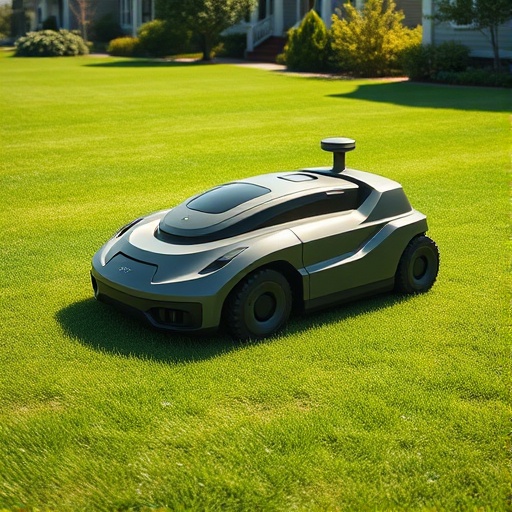
Husqvarna CEORA
Flagship FleetBest for broad soccer, football, and baseball outfield acreage where a grounds director wants a true commercial fleet platform and repeatable virtual boundaries.
- Cutting width
- 26.8 in with the RZ 43M deck.
- Area capacity
- 6 acres ±20% Husqvarna lawn-size rating; not a per-charge claim.
- GPS/RTK navigation
- EPOS RTK-GNSS with reference station and virtual boundaries.
- Weather/rain sensing
- IPX5 weatherproof; no separate rain-sensor specification listed by Husqvarna.
- Fleet-management app
- Husqvarna Fleet Services with cellular telemetry and FOTA updates.
- Safety / bumper
- Lift and tilt sensors plus safety systems; no bumper-contact rating published.
- Slope handling
- 20% inside the installation and 15% at the virtual boundary.
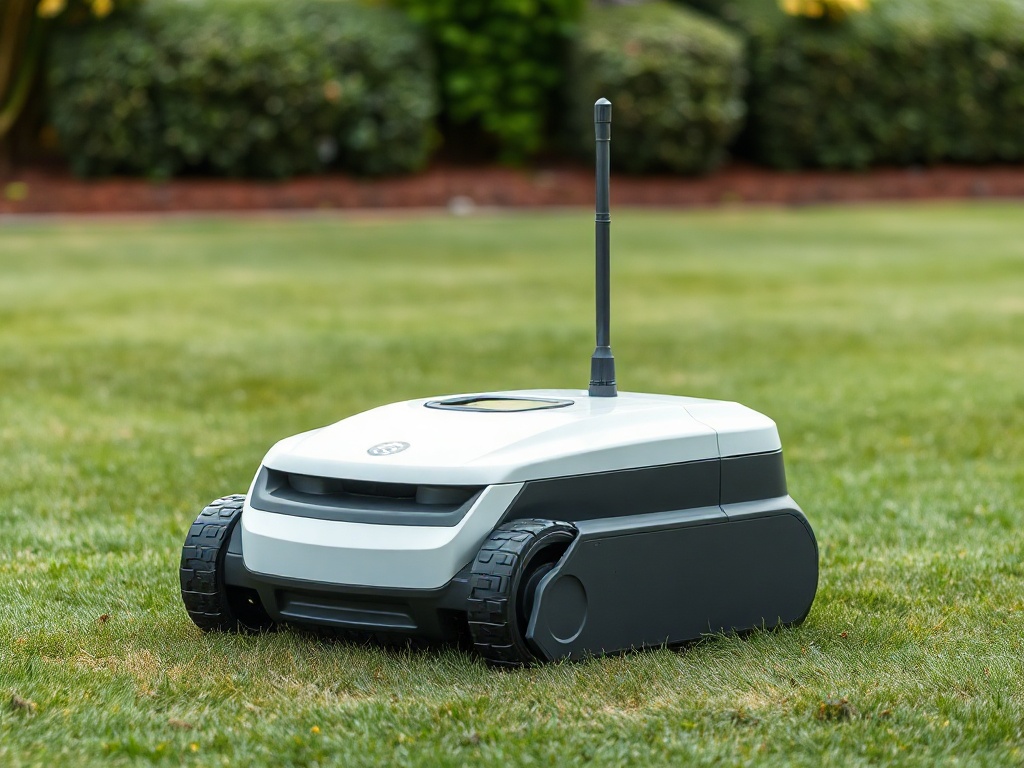
Kress Mission Mega (KR236)
Multi-ZoneBest for wire-free multi-zone programs that need a large scheduled area rating, RTKn routing, and a documented rain-sensor pause.
- Cutting width
- 13.8 in (35 cm).
- Area capacity
- 6 acres recommended every 48 hours; 9 acres maximum every 72 hours. Schedule rating, not per-charge.
- GPS/RTK navigation
- RTKn wire-free navigation with a reference network and virtual boundaries.
- Weather/rain sensing
- Rain sensor pauses mowing during precipitation; return-to-dock behavior is configurable.
- Fleet-management app
- Kress Mission app with multi-unit fleet management.
- Safety / bumper
- OAS obstacle avoidance and lift sensor; no bumper-contact rating listed.
- Slope handling
- Up to 40% (22°) on the manufacturer rating.
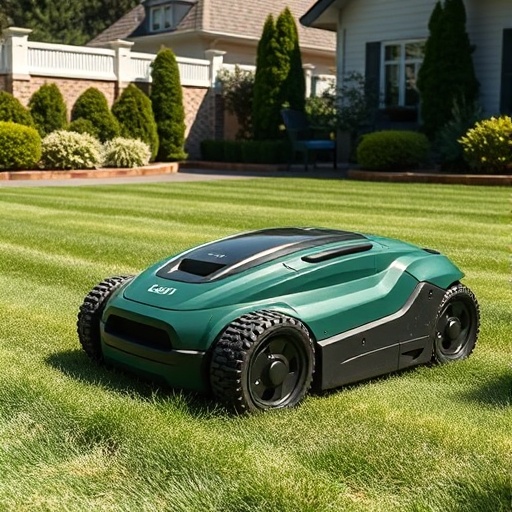
Husqvarna Automower 535 AWD
Slope/Stripe ProBest for steep stadium surrounds, raised spectator berms, and sideline banks where all-wheel drive matters more than wire-free RTK mapping.
- Cutting width
- 9.5 in.
- Area capacity
- 1.25 acres ±20% Husqvarna lawn-size rating; not a per-charge claim.
- GPS/RTK navigation
- GPS assist is listed, but mowing navigation uses boundary and guide wires rather than RTK.
- Weather/rain sensing
- Weather Timer and weather-resistant construction; no separate rain-sensor specification listed.
- Fleet-management app
- Husqvarna Fleet Services and Automower Connect, connectivity kit dependent.
- Safety / bumper
- Lift and tilt sensors with bumper/contact response that stops the mower at impact.
- Slope handling
- Up to 70% (35°) with all-wheel drive.
Where the Fleet Actually Runs
Three scenes that show up on a typical sports-field deployment plan — field-edge mapping, rain-delay operation, and striped outfield aesthetics.
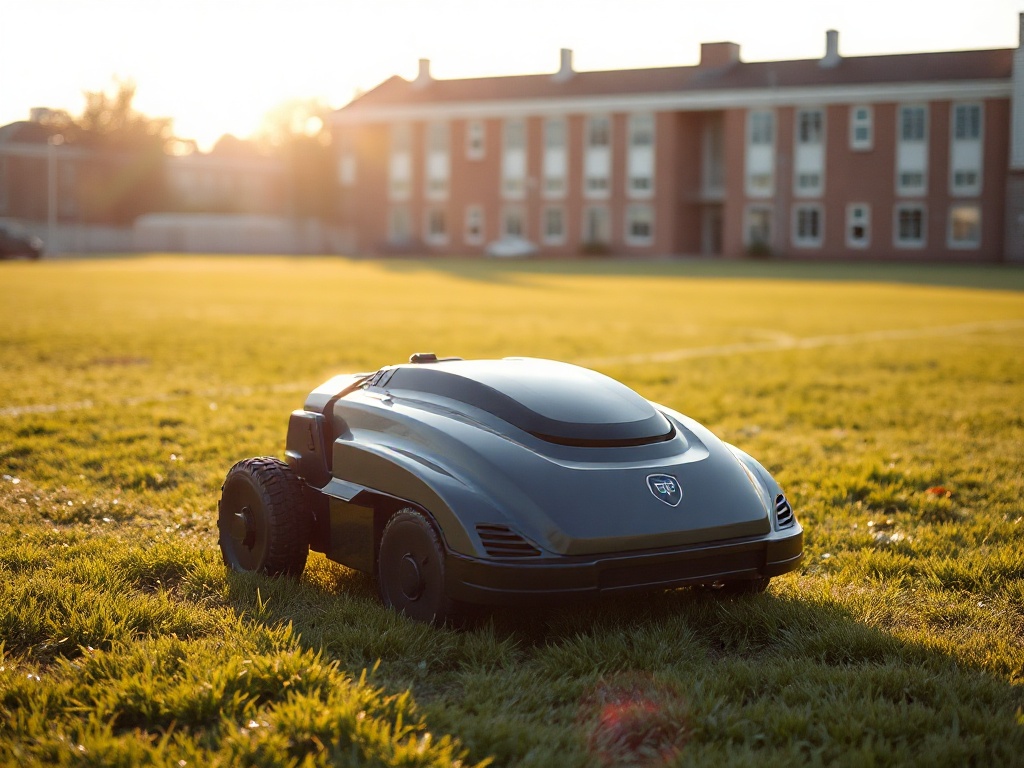
A 3–4 unit fleet handles varsity, JV, and practice outfields on staggered daily schedules. RTK zone maps define per-field boundaries; the robot auto-hands-off between distributed charging docks without operator intervention.
Kress Mission Mega's rain sensor pauses the mower; CEORA and 535 AWD rely on weatherproof construction and schedule controls rather than the same published sensor specification. Set a deliberate dry-out window before resuming so wet clippings do not smear the playing surface.
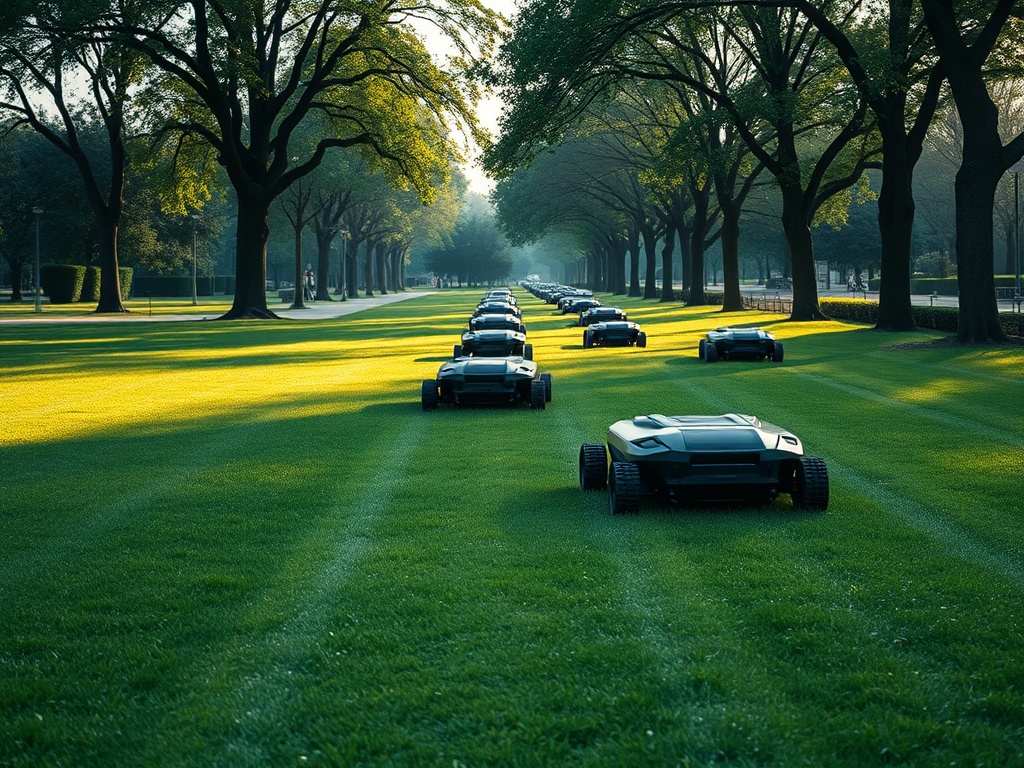
Where RTK-guided routing is available, repeatable paths and daily-cut frequency produce consistent alternating-direction stripes that hold up in broadcast view. Boundary-wire deployments can also repeat a pattern, but they need more deliberate field layout and operator oversight.
ROI on a Sports-Field Fleet
A typical 3–4 unit CEORA + Kress deployment at a 4–6 field school or club complex pays back against the manual grounds-crew budget in 2–4 years.
1. Labor-Cost Displacement
A 3–4 unit fleet run by a single part-time operator replaces the bulk of the multi-field mowing labor that historically took a 4–6 person small grounds crew. Most school and club operations consolidate that into overnight autonomous runs plus a daytime team focused on logo precision and infield skin work. Headcount reduction is the dominant savings line.
2. Fuel & Insurance Savings
Battery-electric autonomous operation replaces the gas-powered riding mowers that account for the bulk of grounds-fleet fuel spend. Workers' comp exposure on steep sideline embankments — historically one of the highest injury-rate tasks at a sports facility — drops significantly with the operator-robot substitution.
3. Turf-Quality Gains
Daily-cut frequency on multi-field outfields produces visibly denser, healthier turf than the twice-weekly manual schedule that small in-house grounds crews can sustain. The aesthetic difference shows up in play quality, broadcast consistency, and parent / fan perception at game day.
The conservative purchase framing: a 2–4 year payback against the displaced grounds-crew budget, with 5–7 year cumulative savings typically in the $150,000–$400,000 range versus the manual baseline at a typical 4–6 field school or club complex. Schools that pair the deployment with a deliberate headcount reduction see the shortest paybacks; clubs where contractor mowing is the alternative baseline model the ROI differently — comparable savings but against a contracted line item rather than an in-house payroll line.
Frequently Asked Questions
Commercial robotic mowers handle soccer and football outfields, practice fields, and the bulk of open-field acreage reliably today — the wide, daily-cut zones where 24/7 autonomous operation produces the largest labor savings. Multi-field complexes typically put 70–85% of total mowed acreage in autonomous-cuttable zones (outfields, practice pitches, perimeter bands) and 15–30% in operator-required precision zones (center-circle logos, goal-crease touchlines, infield skin edges on baseball diamonds). Logos cut at uniform heights for broadcast or sponsor visibility, and infield skin worked to a specific lip, still need a precision crew.
Kress Mission Mega documentation lists a rain sensor that pauses the mower; Husqvarna CEORA is rated weatherproof, and Automower 535 AWD uses weatherproof construction and Weather Timer rather than a published rain-sensor specification. For school and club deployments, the rain-delay strategy is to set a generous dry-out window (2–4 hours after rain stops) before resuming cut, so wet clippings don't clump and smear the surface during peak use hours.
Yes — modern wire-free platforms like CEORA and Mission Mega produce consistent alternating-direction striping because the RTK-guided route is repeatable to centimeter accuracy, and the daily-cut frequency keeps the turf canopy low enough that stripe contrast reads cleanly. Striping consistency is one of the headline benefits versus a weekly manual crew whose stripe pattern shifts with operator fatigue, weather windows, and equipment changes.
A single RTK reference station is mounted on a fixed point with clear sky view (often a maintenance building rooftop or dedicated pole), and per-field zone boundaries are mapped once in the Fleet Services or Kress Mission app. Each field — varsity pitch, JV pitch, practice field, baseball outfield — gets its own zone with its own cut height and schedule. The robot auto-hands-off between charging docks distributed around the complex, so a 3–4 unit fleet covers a typical 4–6 field facility without operator intervention.
A 3–4 unit CEORA or Kress Mission Mega fleet on a typical 4–6 field school or club complex typically pays back in 2–4 years against a small in-house grounds crew, with strong cumulative savings because school-district grounds budgets are tightly audited. The variables are local labor rates, current grounds-crew size, the share of acreage pushed to autonomous cut, and whether procurement is structured as capital purchase or 3–5 year lease. Schools that pair the deployment with a deliberate headcount reduction see the shortest paybacks; clubs where grounds work is contracted out tend to model the ROI differently.
Yes — daily-cut frequency is actually the right answer for aggressive bermuda growth, and the CEORA-class platforms handle 1.5–2.5 inch outfield heights at the coverage rates required. The flagship platforms in this guide are best matched to open outfield acreage; AWD platforms handle the sloped sidelines typical of multi-field complexes where walk-behind slope mowing is the historical injury exposure.